Auditory Processing Disorder in Children

Auditory Processing Disorder (APD), also known as central auditory processing disorder (CAPD), is a complicated problem affecting about 5% of school-aged children

Attention Deficit Disorder in Children

Levy Learning Center is the number one ADHD tutoring center in Florida., providing ADHD treatment for children.

Orton Gillingham Reading Program

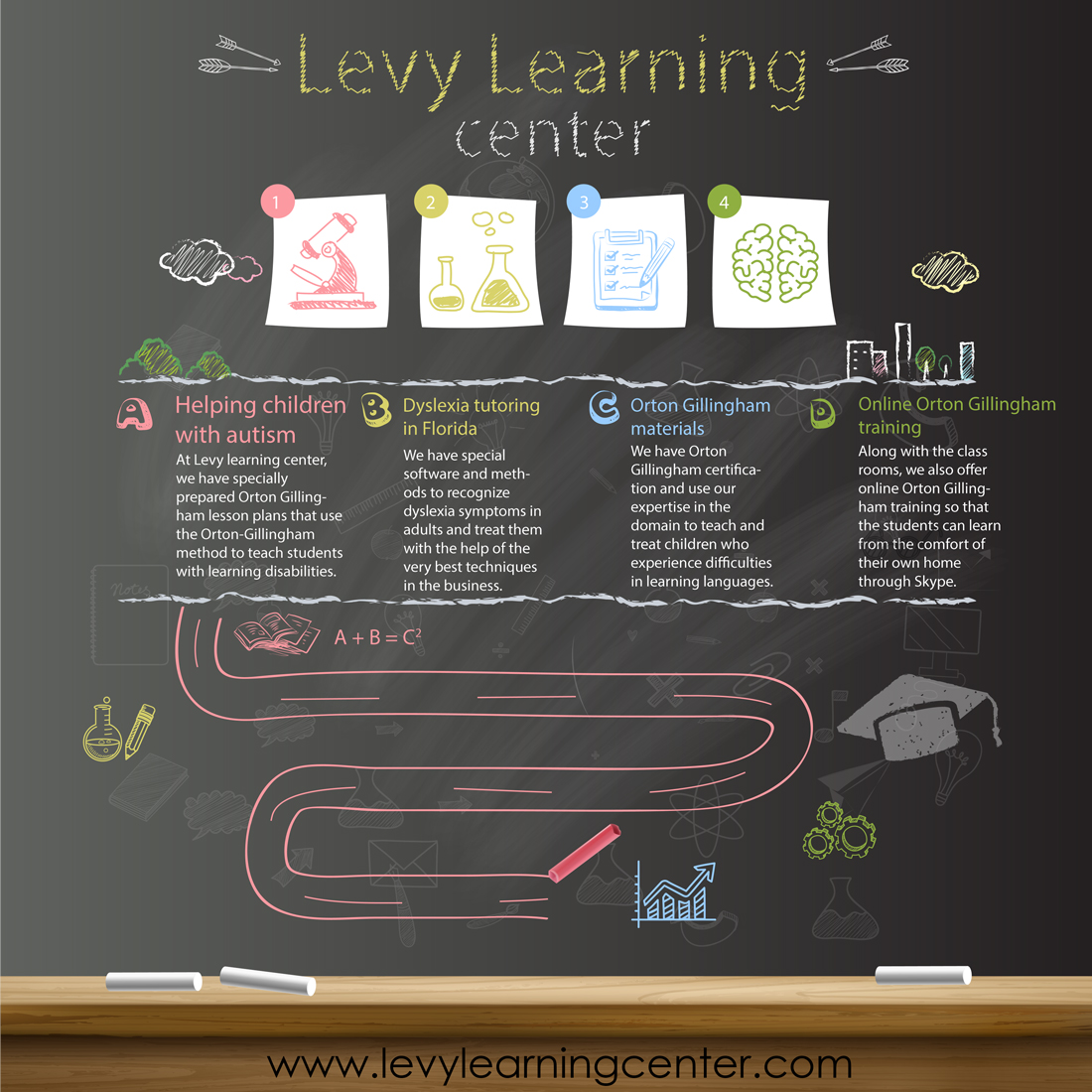
Orton-Gillingham is an intensive, sequential phonics-based system that teaches the basics of word formation.

Dyslexia Symptoms in Adults

Our dyslexia specialists are trained in the Orton-Gillingham method, providing dyslexia programs for children

Autism Spectrum Disorder

Children with Autism Spectrum Disorder have differences in the way their brain matures and sorts out information.

Showing posts with label auditory processing disorders. Show all posts

Friday, 27 April 2018

The History of Orton Gillingham Tutoring


Orton Gillingham tutoring is basically an approach conceived and designed by two people - Samuel T. Orton and Anna Gillingham. It is misinterpreted by many as a program, wherein it is just an approach, which only a well trained and experienced trainer can use effectively with the dyslexic people.

The Use

The Orton Gillingham approach is directed towards helping people who have problem in writing, reading and spelling. These are usually associated with dyslexics.

The main content and the practice that forms the foundation of the Orton Gillingham tutoring approach is taken from two sources – proven knowledge and practice approved and legalized over 70 years.

The second source is the scientific evidence of how humans learn to read and write; how some people find it difficult to read and write; why dyslexia makes attaining literacy skills difficult; and the instructional method well suited for helping such people read and write.

The founders

Orton Gillingham approach is all work of contribution of Samuel T. Orton and Anna Gillingham. Orton was a pathologist and neuropsychiatrist. His work revolved around reading and language processing difficulties. By 1925, he had recognized dyslexia as an educational problem.

Anna Gillingham was a psychologist and educator, had a command over the language. By 1930s, Dr. Orton got instructional techniques published. This became the foundation for the Orton Gillingham tutoring.  

Orton Gillingham Approach is one-on-one teacher-student instructional model often applied in small group instructions. It has been successfully done in the classrooms. Though it was initially designed for students with reading, writing and spelling difficulties, it has been found to be more effective for students in mathematics.

Summing up

Students afflicted with dyslexics are required to hone their language skills and its relation with writing. Orton Gillingham Tutoring is their savior since they need special help; they get it aptly with it.


Thursday, 22 March 2018

10 Signs that Say, ‘Your children have Auditory Processing Disorder


Before we zero on and say with an affirmation that your children has auditory, let us understand what is it?

Auditory Processing Disorder is

When the central nervous system, CNS, or APD doesn’t function well and thus pave way for a not so healthy relationship between the nervous system and the ears. This condition leaves a child helpless. He cannot understand the language or the sound.

APD or Auditory Processing Disorder causes issues with:
  • Understanding a particular language
  • Remembering the information
  • Processing the conversation

Generally, it comes across as a very chaotic condition. So, one must look for the following signs before coming to any conclusion.
  • Cannot differentiate words in a noisy environment.
  • Cannot follow any directions.
  • Problem in making it difficult to separate any sound or speech
  • Cannot read or spell
  • Cannot comprehend any information within a classroom which other children can easily do.
Well, these symptoms may or may not mean auditory processing disorder for sure. So, do not conclude by reading the symptoms mentioned above that child has an auditory processing disorder. The situation is a little tricky. But these symptoms do throw some light of suspicion. Do not ignore them.

Seek professional help. They are fully qualified and can tell you exactly about its status. A group of professionals involved in the process of APD identification include psychologists, speech language, pathologists, and teachers.

In Conclusion

Well, it’s only half the purpose solved. Now begins the most important part – the APD treatment. Remember, different children respond differently to the treatment. Some are able to overcome it completely; others may not and live with it all their lives. This depends on how bad APD is and how quickly you start taking the professional help.


.


Wednesday, 28 February 2018

Auditory Processing Disorder in Children: Home Care Tips


A child’s primary school is his home and his first teachers are his parents. Henceforth, parents are advised to be on the child’s side to make him have the confidence to face the world.

Home care is extremely important in children with auditory processing disorder. One has to be on a child’s side to ensure he is getting ready. Here is how to go about it.

Have compassion

Love and compassion can fasten healing and instill courage in children with auditory processing disorder. Such children respond slowly. Having the understanding and patience will help him pick up the loose ends.

Make your child face you when you are instructing him

Facing in another direction implies that he is distracted towards something else, probably listening and processing another thing. So make him have his face towards you and listen with his eyes on you. This ascertains that he listens carefully and processes it properly.
 

Short instructions

In children with auditory processing disorder, remembering and understanding long instructions is difficult. So keep them short and precise. Do not ask him to do many things; just one single instruction would be sufficient in his case.

Double check if the child understands

This is vital. You must ensure that he has understood the thing told by you. Do not lose your cool if he hasn’t. Ask him again and see to it that he understands it. This is the way to get things done.

Make a chart

Parents should make a chart of the activities a child has to undergo in the morning. A pictorial representation of the activity is even better to make things work. He will find it easier and work faster.

Summing up

Parents have a key role to play in auditory processing disorder in children. Be on his side to make him win.

LSI - auditory processing disorder

Thursday, 11 August 2016

Treating Auditory Processing Disorder

Lately, there has been a sensational upsurge in expert and open familiarity with Auditory Processing Disorders (APD), additionally alluded to as Central Auditory Processing Disorders (CAPD). Lamentably, this increment in mindfulness has brought about a plenty of misguided judgments and deception, as well as perplexity in regards to exactly what seems to be (and isn't) an APD, how APD is analyzed, and strategies for overseeing and treating the confusion.
 
The term sound-related preparing regularly is utilized freely by people as a part of various settings to mean a wide range of things, and the name auditory processing disorder in children has been connected (frequently erroneously) to a wide assortment of challenges and clutters. Therefore, there are some who address the presence of APD as a particular demonstrative substance and other people who expect that the term APD is pertinent to any kid or grown-up who experiences issues listening or comprehension talked dialect. The motivation behind this article is to clear up some of these key issues with the goal that perusers are better ready to explore the wilderness of data accessible on the subject in expert and prominent writing today.

Wording and Definitions

In its exceptionally broadest sense, auditory processing disorder in children alludes to how the focal sensory system (CNS) utilizes sound-related data. Notwithstanding, the CNS is limitless furthermore is in charge of capacities, for example, memory, consideration, and dialect, among others. To abstain from mistaking APD for different issue that can influence a man's capacity to go to, comprehend, and recall that, it is critical to underscore that APD is a sound-related shortage that is not the consequence of other higher-request psychological, dialect, or related issue.

Monday, 28 December 2015

USING ORTON GILLINGHAM TO TREAT AUDITORY PROCESSING DISORDER

Auditory processing disorder (APD) in children is the manner in which a child’s central nervous system makes use of auditory information. It is an auditory deficit rather than a consequence of higher-order language, cognitive and related disorders. Nonetheless, there are cases when APD comes along with other sensory-related conditions.

levylearningcenter


Diagnosing APD
APD in children is manifested through difficulty in listening and related problems. For instance, they may fail to follow directions, differentiate corresponding sounds and above all, fail to understand speech in any noisy setting. These children tend to behave as if they are victims of hearing loss. They also have certain difficulties in reading, spelling and listening to verbal texts. However, these symptoms alone cannot be used to diagnose APD since a child may exhibit them yet their nervous system is fully intact.

APD can be treated and taught using the Orton Gill-Ingham method. This is a technique that gauges their class performance on other aspects rather than their listening skills. Note that this is the best way to evaluate their progress since they have the potential to complete all tasks in time as long as they are informed of the results expected from them.

The Orton GillIngham method is a multisensory structured language program. In addition to phonology and its awareness, the learner is introduced to association of sounds and symbols. Their instructed using syllables and morphology. After completion of this program, a child ailing from APD can fit in the ordinary classroom and even perform better than their classmates.